
It all started with a question...

Hi, I’m Del. And all of this started with a question I couldn’t answer.
In 2013, my friend Seneca from Freedom Flowers asked me something along these lines:
“If the Hebrew culture says their letters are living, then they have a frequency. Can you figure it out?”
I was clueless. But now I was curious. So I started looking.
One question opened a door. Behind it was another question. And another. More than twelve years later, I’m still opening doors.
Then, people started sending me things...
Once people knew what I was exploring, the pile started growing—articles, ideas, claims, links they'd found on social media, videos, and anything else that looked as though it might belong on my desk.
This was 2013, when reliable information wasn't always easy to track down online. One source could lead to another, which could lead somewhere else entirely. There was a lot of digging involved.
Somewhere in that pile, the Ancient Solfeggio Frequencies showed up.
Now, give a classically trained musician a list of frequencies and what is she going to want to know?
What notes are they?
It seemed like a simple enough question.
It wasn't.
Before long, I was pulling music theory and history back off the shelf and revisiting things I'd conveniently filed away under “Surely I will never need this again.”
Apparently, the Ancient Solfeggio Frequencies had other plans.
Apparently, I was going to need music theory
Finding the notes behind the frequencies turned out to be more complicated than I expected. A frequency might give you a number, but that number doesn't tell you the whole musical story. What concert pitch are we using? What tuning system? What temperament? And what happens when we look at the same question historically rather than through a modern piano keyboard?
Suddenly, things I had studied and taught—and, in some cases, happily put back on the shelf—were becoming useful again.
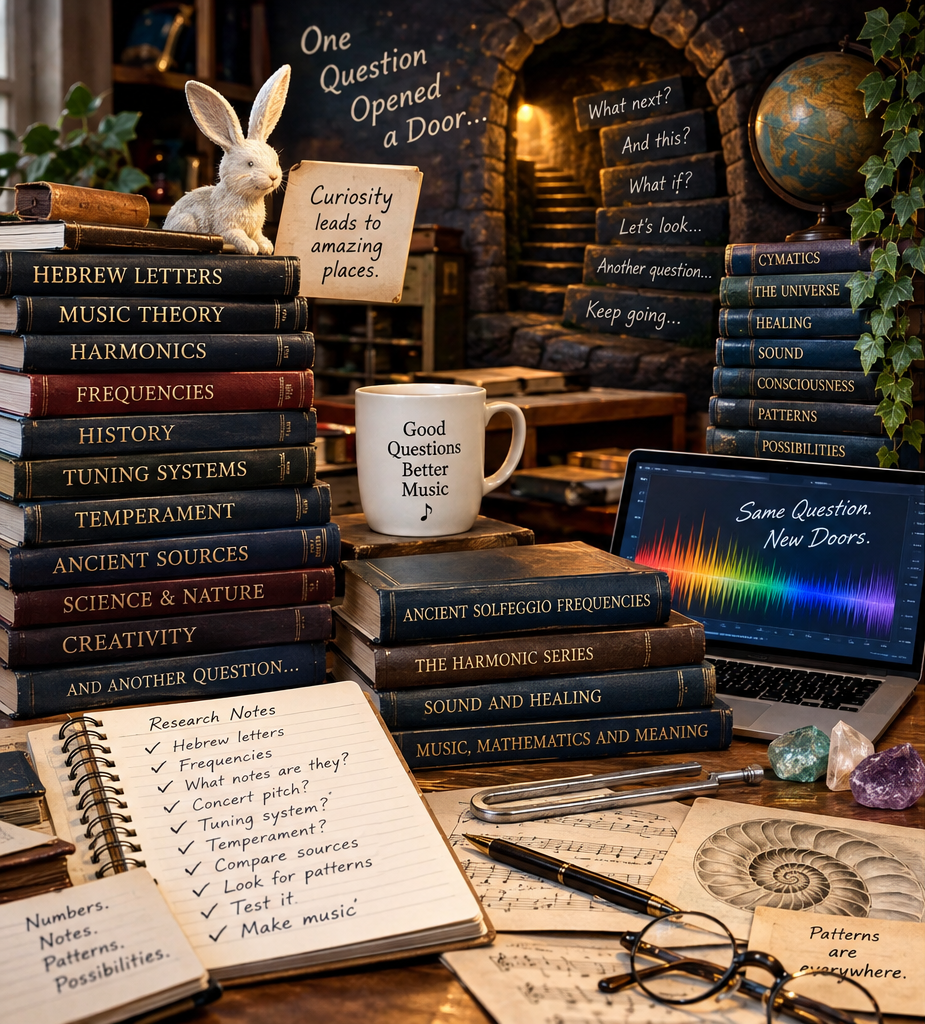
I was also beginning to realize that asking “Is this true?” wasn't always the most useful place to start. Sometimes the better questions were: What can I observe? What can I measure? What happens when I compare this with that? And does the pattern hold up?
Music theory led to tuning and harmonics. Numbers began connecting with patterns. Historical claims sent me looking for original sources. Sometimes an idea held up. Sometimes it fell apart. And sometimes the most interesting result was another question.
Creativity makes connections. Scholarship tests them. And then I make music.
Around this same time, I was taking a class with Seneca where each of us had to choose something we were good at and see if we could turn it into a business.
By then, my frequency research was piling up. The others kept encouraging me to do something with it, although I wasn't particularly excited about building a website to house all that research.
Eventually, sometime in the fall of 2014, I found myself thinking: Well... apparently I'm building Healing Frequencies Music. There was no grand plan. I simply gave the questions a place to live.
The questions took form as I went.
Meanwhile, another door opened
That didn't go quite as expected.
Instead, I found myself listening to a presenter who was talking about the mysteries of God—and answering questions I had never heard anyone answer before. I went home thinking about an entirely different set of questions.
And then I started dealing with my junk. Plain and simple.
There were old hurts, trauma, anger, beliefs and patterns that needed attention. So, what did I do? I began practicing what I was learning. I also began exploring more deeply how the spirit, soul and body work together and what it might mean to become whole.
At first, this seemed completely separate from the frequency research.
It wasn't.
The two paths continued alongside each other, and somewhere in the middle of all of this, something remarkable happened.
By 2015, I was healed from an illness I'd lived with for 19 years.
Something was changing in the music, too. I'd been creating music spontaneously for years, but now I began to hear what I can only describe as a new sound coming out of me. The music was coming from what was happening inside me.
I was beginning to realize that Healing Frequencies Music might be about something much larger than frequencies.
The music didn't actually start there
Around 1998, I began sitting at the piano with no music in front of me and creating.
It wasn't easy. I had spent years learning how to play what was on the page. Now I had to learn how to play what wasn't.
So I practiced.
Over time, creating music spontaneously became another musical language—one that drew on all those years of training without needing a written score to tell me what came next.
And there's something I learned through both kinds of music that eventually became important far beyond the piano:
Understanding is not mastery. Practice changes how we function.
Click image to purchase book on Amazon.
Wholeness unfolds in layers
Sometimes that meant dealing with an old hurt or changing a pattern of thinking. Sometimes it meant getting my emotions to settle down long enough to hear something other than themselves. And sometimes understanding what needed to change was the easy part.
Living differently took practice.
Over time, Perfect Love became central to how I understood that process: flowing through the spirit, into the soul, and ultimately into the body. As old things were cleared away, I also began discovering more about identity—who I am, who I was created to be, and what it looks like to live from that place.
There was never a point where I could say, There. Finished.
Wholeness seemed to unfold in layers. One discovery prepared me for another, and often what I learned in one season prepared me for something I couldn't have understood earlier.
Some doors don't open until you're ready to walk through them.
Where it all comes together
Somewhere along the way, I stopped seeing all of these things as separate rabbit holes.
What we understand has to become something we know how to live.
And music kept weaving its way through all of it.
Sometimes research gives me something new to explore musically. Sometimes creating music helps me notice a connection I hadn't seen before. And sometimes life hands me another question and sends me right back down the rabbit hole.
That's what Healing Frequencies Music has become: a place to explore the connections between music, frequency, creativity, identity and wholeness—and to see what happens when we put what we discover into practice.
I don't expect every question to have an answer. I've learned that a good answer usually produces several more questions.
That's part of the fun.
The musician behind the rabbit holes
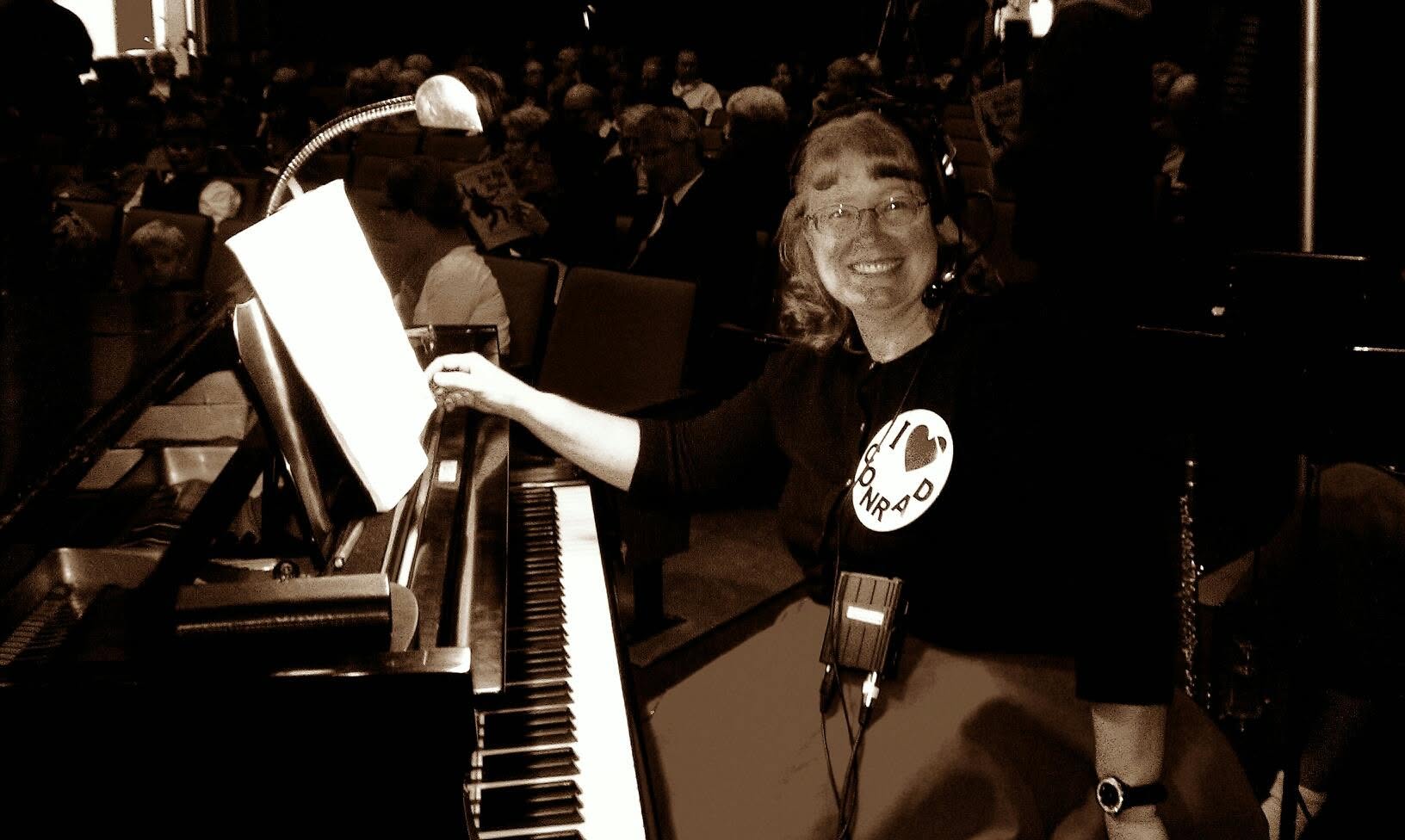
Music Director for Moscow Community Theatre
Long before Healing Frequencies Music, there was a clarinet, a lot of practice, and a life spent performing and teaching music.
I began teaching in 1986 and spent four decades helping students do more than play the right notes. I wanted them to understand what they were doing, why it worked, and how to practice so that understanding became something they could actually do.
Along the way, I earned a Bachelor of Music from the University of Idaho, a Master of Music from Yale University, and a Doctor of Musical Arts from the University of Washington. I also spent more than three decades performing professionally.
I had no idea how much of that training I would eventually pull back off the shelf for Healing Frequencies Music.
Turns out, those music theory and history classes weren't finished with me after all.
And because you shouldn't have to take my word for it, here are two recordings from one of my clarinet recitals.
This first piece is Sonatine for Clarinet and Piano written by Caroline Schleicher-Kramer. The pianist is Mac Merchant.
This next selection was written by Johannes Brahms. It's the first movement of his f minor Sonata for clarinet and piano. Mac Merchant is the pianist.
Here's a few of my favorite things
Want to learn more about what I do?
Click on the link to check out my other websites!

Listen to Samples!
This page includes samples of ALL the music! Some albums include a corresponding "sound essence," and others have a list of emotional roots of physical symptoms. Listen, choose the albums you desire and then purchase through Gumroad!
Click on image to listen!

Personal Music!
Personal music comes with a variety of choices. Sign up for a monthly subscription. Order a personal keyboard song or a Frequency Immersion sound bath (with crystal singing bowls). Or, sign up for coaching/mentoring for help with your creative project.
Click on image to learn more!

EMDR Music!
Very few musicians are putting out "bilateral" music that's often used in EMDR sessions. With the help of a trained EMDR therapist, I've created music that's meant to assist on healing journey's specifically addressing emotional issues.
Click on image to learn more!
Already know what downloads you want?
#1
5/5
Download Directly Through Gumroad!
If you already know what you want after listening to SAMPLES, you can go directly to my Gumroad store. From there you can download several items at the same time! My Gumroad store includes items from others websites so check it out!
