

Music taught me things I didn’t realize I was learning.
Reading sheet music, spending hours in practice rooms, rehearsing with other musicians, and finding my place in an ensemble were preparing me for more than a performance. Those experiences taught me how to listen, pay attention, work through frustration, and keep going when something didn’t come easily. But let’s not pretend I understood any of that in sixth grade.
When I first joined band, I was terrible. I didn’t particularly like practicing. How many sixth graders do you know who enthusiastically announce, “I think I’ll spend the afternoon working on scales”? At the time, ballet had most of my attention. My uncle was the band director, and he made joining band sound appealing. Practicing the clarinet afterward? Apparently, that was a separate agreement.
Something began changing in seventh grade. We had band every day, and I started recognizing a connection: if I practiced, I might improve. Perhaps I could even move up from last chair. I’d already experienced that connection in ballet. Now I needed to apply it somewhere else.

Then life rearranged things. We moved to a city without a ballet school, and there was no band available to me in eighth grade. But we had a piano at home. That piano got plenty of attention. Just don’t ask me to play Scott Joplin’s The Entertainer in front of my brothers. You’ll receive an emphatic NO! They heard enough of my practicing to last them a lifetime.
What Are We Actually Practicing? You’ve probably heard the saying, “Practice makes perfect.” I disagree.
HOW we practice helps determine what we learn.
If I repeatedly rush through a difficult passage, missing the same notes each time, I’m rehearsing those mistakes. Spending another hour doing it the same way doesn’t necessarily solve the problem. A metronome is particularly good at pointing this out. It doesn’t care whether I think I played something correctly. It keeps ticking. We joked in college that the metronome is a musician's best friend. Musicians begin slowly enough to notice what their hands, ears, breath, and attention are doing. We work on a passage until we can play it reliably, then increase the tempo. If the notes begin falling apart, we slow down again.
That isn’t failure. It’s useful information.
Sometimes we isolate two notes. Sometimes we change the rhythm, work on the breathing, or take a break and return with fresh ears. The goal is to find a way of practicing that helps us move forward. Over time, something that once required intense concentration becomes more familiar. Our fingers find their places. A phrase begins to flow. We have more attention available for expression because we aren’t struggling quite so much with the mechanics.
Anyone listening to the finished performance hears the result. They don’t hear every awkward attempt that helped us get there.
Lessons Beyond the Practice Room
At Yale, I encountered excellent musicians who were also studying medicine. When graduate musicians were called upon to fill out the general college orchestra for larger works, I had opportunities to play alongside some of the medical students who were part of that orchestra. Conversations with them introduced me to a connection I hadn’t considered. They told me their musical backgrounds had helped their medical-school applications.
Their explanation made sense to me. Music had required sustained attention, preparation, persistence, and the ability to bring technical understanding together with interpretation. Those were abilities they could carry into another demanding field. I began looking differently at what happens in a practice room. We’re learning a piece of music, certainly. But we’re also practicing how to approach something we cannot yet do.
Many years later when I was a teacher, I found several studies on music and learning. I compiled all that information into a document that I sent with the music education majors to give to their school administrators. When I found this study below, I was reminded of the amazing medical student musicians I'd encountered at Yale. Here is the information I put into that document for my own students:
"Did You Know? Music majors are the most likely group of college grads to be admitted to medical school. Physician and biologist Lewis Thomas studied the undergraduate majors of medical school applicants. He found that 66 percent of music majors who applied to med school were admitted, the highest percentage of any group. For comparison, (44 percent) of biochemistry majors were admitted. Also, a study of 7,500 university students revealed that music majors scored the in highest reading among all majors including English, biology, chemistry and math. Sources: The Comparative Academic Abilities of Students in Education and in Other Areas of a Multi focus University, Peter H. Wood, ERIC Document No. ED327480 and The Case for Music in the Schools, Phi Delta Kappan, February, 1994"
For an accessible introduction to what playing an instrument asks of the brain, watch Anita Collins’s short TED-Ed video, How Playing an Instrument Benefits Your Brain.
You don’t need to become a musician to consider the question...
What might we be learning through the things we repeatedly do?
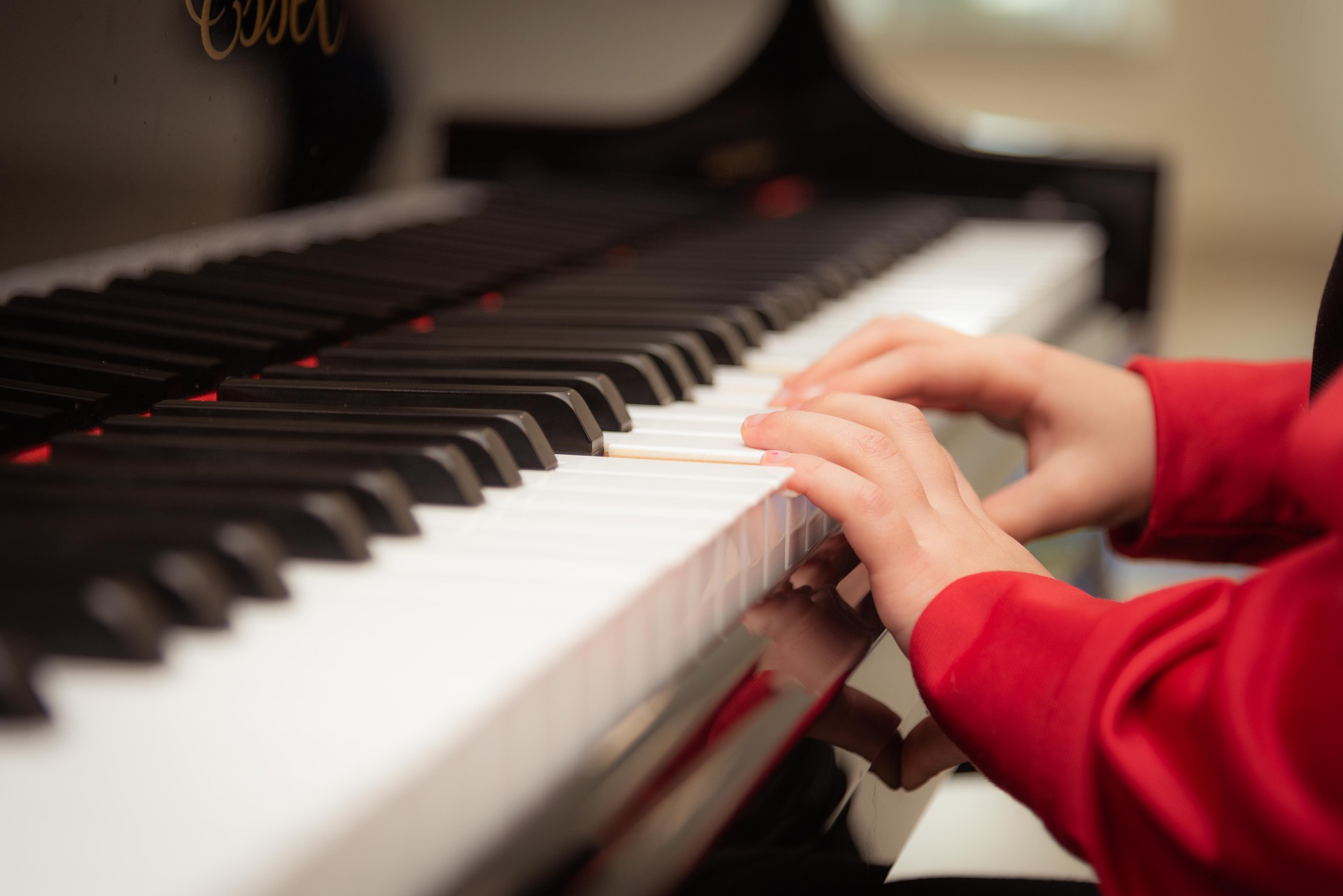
Could We Practice a Different Response?
Years later, I began recognizing connections between my musical training and changes in my own life.
Understanding an idea was a beginning. Living it required practice. I could appreciate the idea of peace while still responding to a difficult situation in a familiar way. Recognizing that response gave me somewhere to begin. What was I doing? What was I expecting? Could I pause long enough to try something different? That didn’t mean I could control every circumstance or prevent painful things from happening. It meant exploring how I responded to what happened.
The practice-room lesson returned: begin somewhere manageable.
A musician doesn’t start with the most difficult passage at full speed and declare themselves incapable when it falls apart. Why would we expect ourselves to respond perfectly to life’s hardest moments while we’re still learning? We can slow down. Notice. Adjust. Try again. A difficult day doesn’t erase what we’ve learned. It may reveal something that needs a little more attention—or support.
Where Do Our Patterns Come From?
This brings me to questions I want to explore in this series. Why do some responses become so familiar? What do we learn from the people around us? How do our experiences influence the way we think, feel, and behave? And what happens in the body as those patterns develop?
Genes are part of that discussion. So is the environment in which we live. Epigenetics examines mechanisms that affect how genes function without changing the underlying DNA sequence. It gives us another way to investigate the relationship between biology and experience. It doesn’t explain every habit or every change, but it opens an important door. NHGRI: Epigenetics And our environment includes more than what we eat, breathe, or encounter physically.
It also includes our relationships.
In the next article, we’ll begin exploring research into relationships, stress, and epigenetics—and consider what those findings might mean, alongside what they cannot yet tell us. For now, you don’t need to understand every biological mechanism to ask yourself one useful question:
What is one response you would like to practice differently? Choose something small enough to begin. You don’t have to perform the whole concerto today. Let's look an example to get your creative juices thinking...
When I first became a band director, I was a bit on the unorganized side. My office (and my home) were a bit cluttered. I began to realize how much time I wasted just looking for things. What if I could practice being more organized? At first, the thought was fleeting because it seemed impossible to do. After all, I'd spent my whole life being disorganized. Now, I had to practice doing something different. Redeeming wasted time was important to me. But, was I willing to do anything about it?
We can wish, hope, pray, or whatever else we do where we want things to change; it's an action that begins the process. Not until I began to do small things with my organizational issues on a consistent basis (like daily), did I eventually see some fruit in my efforts. It wasn't overnight, and not even weeks, but probably a few months of organizational practice before I saw lasting positive results. Not that I'm perfect, but I'm more cognizant of when I'm wasting time and energy living and functioning in a state of disorginazation.
What did I do to faciliate the change? I began with small things such as picking up after myself. I decided to no longer leave things laying around to deal with later. I had to remind myself to put stuff away when I was done with them because my old pattern was to just leave things. The more I followed through, the easier it got. Eventually, I no longer had to think about it as much. Picking up after myself became an unconscious behavior. The amazing part? I realized this simple action changed everything! You can probably guess why that is.
Being aware of an issue is the first step. Making a decision to do something different is the second step. The third step is the action or follow-through behind the desire. Just like practicing a concerto to perform with an orchestra, our life behaviors adjust over consistent practice of a new (and better) way of functioning. As they said to us in college, "Go Practice!" Enjoy the journey and give yourself some grace when you don't get it right each day you practice.
Del, October 2026
Suggested Video Viewing
- Bruce Lipton – Video: The Science of Creating Heaven on Earth
- Dr. Joe Dispenza – Video: This Is How You Break the Habit of Being Yourself | Dr Joe Dispenza Explains.
These videos will be discussed in a future article so enjoy them before we get there! Dr. Bruce Lipton gives some amazing explanations and visuals for how epigentics works in behavior and relationships.
I put a recent video up on the Healing Frequencies Music YouTube channel titled, Practicing Wholeness, where I give details on how we can use the everyday practice tools of musicians to change unhealthy behaviors in our lives.